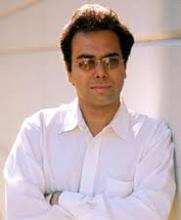
Seminar by Prof. Srinivasan S. Iyengar( Indiana University, Bloomington, IN-40401, USA) on "Quantum algorithms for chemistry: three pieces of one puzzle".
22 May 2025
Seminar Room # 350, second floor annex
------------------------------------------------------------------------
Speaker: Prof. Srinivasan S. Iyengar
Professor, Department of Chemistry,
Adjunct Professor, Department of Physics,
Indiana University, Bloomington, IN-40401, USA
Title: "Quantum algorithms for chemistry: three pieces of one
puzzle".
Day and Date: Thursday, May 22, 2025
Time: 16.30 Hrs.
Venue: Room no. 350, Chemistry Department
Second floor, Annex
------------------------------------------------------------------------
Hosted by Prof. Rahul Maitra
Talk Title : "Quantum algorithms for chemistry: three pieces of one puzzle".
Abstract
The proposal by Peter Shor introduced a quantum algorithm to factorize large integers into their
prime factors in almost linear time complexity. It was later realized that Shor’s algorithm was an example
of a general class of mathematical problems called the “hidden subgroup” with important practical
applications. Complemented by Richard Feynman’s insightful prediction that “there’s plenty of room at
the bottom” and the discovery of atomic clock transitions currently used in the global positioning system,
quantum information science was born and has presented us with the promise of efficiently solving
exponentially complex problems in a variety of domains. As a result, the development of quantum
computing hardware, and its associated quantum software, is a rapidly evolving research frontier in
multiple areas of science and engineering.
Multiple quantum computing technologies, such as ion-traps, superconducting coils, Bosonic
processors with photons, solid-state devices and quantum dots inside cavities, and Rydberg atoms, have
emerged as potential alternative computational platforms to address complex computational challenges.
However, it is now accepted that universal, fully fault-tolerant, quantum computers are a rather distant
dream, and new hybrid quantum-classical frontiers and Noisy Intermediate Scale Quantum (NISQ)
systems have recently emerged. Interleaving computations by alternating between NISQ machines and
classical computers has emerged as a paradigm for effectively exploiting NISQ machines in ways that go
beyond the power of classical computers. In this talk we will present recent advances from our group
towards the development of “hybrid” quantum-classical computing algorithms designed by solving
chemistry problems such as correlated electronic structure and nuclear dynamics. The talk showcases a
strong collaboration between theoretical chemists, atomic physicists and theoretical computer scientists.
In the first half of my talk, I will consider the problem of quantum nuclear dynamics (or quantum
molecular dynamics, where the nuclei and electrons are treated quantum mechanically), and discuss two
approaches for the development of quantum algorithms. These can loosely be characterized using the
familiar analogue and digital descriptions, but now in the quantum regime. Additionally, our algorithms
have been implemented on state-of-the-art quantum platforms in IonQ, Inc. and Sandia National Lab’s
QSCOUT ion-trap quantum computing systems. We have constructed quantum wavepacket dynamics
studies on these platforms for the first time, and by studying the time-evolution of such quantum
wavepackets, using a variant of the phase estimation algorithm, we obtained accurate vibrational
properties for hydrogen bonded systems. As the dimensionality of nuclear degrees of freedom increases,
we also show that using tensor networks, one can construct new, parallel quantum computing algorithms.
Indeed, for the first time we have recently demonstrated parallel quantum computing on IonQ’s 11-qubit
Harmony ion-trap systems.
In the second half of this talk, we consider accurate post-Hartree Fock electronic structure. There
have been several important algorithms introduced in the literature for this purpose, but in all cases,
implementation of these algorithms leads to the quantum circuit depth problem. Here, as the quantum
circuits become deeper and larger, the fidelity of the quantum hardware deeply affects the error obtained
from quantum propagation. While many groups are working on better error correction strategies, our
group has introduced a graph-theoretic procedure to drastically reduce the quantum circuit depth by
several orders of magnitude. We have implemented our graph-theory based algorithms on IBM’s quantum
simulators to study medium-to-large, protonated water clusters and obtained coupled cluster accuracy.
If time permits, we will also discuss how the methods above lead to more efficient machine
learning platforms. Indeed, our group remains strongly focused on the interface of quantum computing
and machine learning.