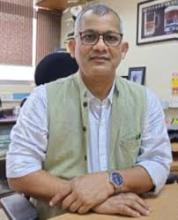
Seminar by Prof. Sundargopal Ghosh (IIT Madras) on "Beyond Boundaries: The Unique Bond Between Boron and Carbon".
03 Apr 2025
Seminar Room # 350, second floor annex
------------------------------------------------------------------------
Speaker: Prof. Sundargopal Ghosh
Department of Chemistry, Indian Institute of
Technology-Madras, Chennai-600036, India
Title: "Beyond Boundaries: The Unique Bond Between Boron and
Carbon".
Day and Date: Thursday, April 03, 2025
Time: 11.00 am.
Venue: Room no. 350, Chemistry Department
Second floor, Annex
------------------------------------------------------------------------
Hosted by Prof. Goutam Kumar Lahiri
Talk Title :"Beyond Boundaries: The Unique Bond Between Boron and Carbon".
Abstract
Unlike carbon, boron does not usually form ring compounds due to its electron deficiencydriven affinity towards polyhedral geometries.1-3 Therefore, the planar boron rings were ignored
for a long time. However, recent developments by us and others demand further attention in
stabilizing planar boron rings. For example, Himmel and co-workers synthesized a derivative of
a doubly base-stabilized [B3H6]
+, the structural equivalent of [B3H8]
- and [B3H9].4a Although the
smaller B3 and B4-rings are mostly isolated as individual species, larger B5 and B6-rings are
stabilized by TMs, depending on the ring size and electronic requirements of the rings.1,4 In this
regard, we have recently synthesized and structurally characterized tetraborane ring [B4H8]
2- and
pentaborane ring [B5H10]
- stabilized by Os-template in ɳ4 or ɳ5
-fashion which mimics [C4H4]
2- and
[C5H5]
- rings, respectively.4c We have also isolated the first examples of a nearly planar [B6H6]
unit, stabilized as a part of [(Cp*Ti)2(μ-ɳ6
:ɳ6
-B6H6)(μ-H)6], where significant electron delocalization
was observed from the Ti–Ti bonding orbital to the μ-H atoms and B6 skeleton.4d The selection
of transition metals mostly depends on their diffuse orbitals, valence electrons, and ring sizes,
while the bridging hydrogens balanced the electron deficiency of the borane rings. These
results will be discussed in detail.