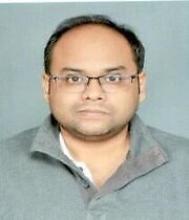
Seminar by Prof. Avisek Das (IACS Kolkata) on "Structure and Dynamics of Colloidal and Molecular Self-assemblies: Insights from Computer Simulations".
28 Feb 2025
Seminar Room # 350, second floor annex
------------------------------------------------------------------------
Speaker: Prof. Avisek Das
School of Chemical Sciences
Indian Association for the Cultivation of Science,
Kolkata, India
Title: "Structure and Dynamics of Colloidal and Molecular
Self-assemblies: Insights from Computer Simulations".
Day and Date: Friday, February 28, 2025
Time: 16.00 Hrs.
Venue: Room no. 350, Chemistry Department
Second floor, Annex
------------------------------------------------------------------------
Hosted by Prof. Rajarshi Chakrabarti
Talk Title : "Structure and Dynamics of Colloidal and Molecular Self-assemblies: Insights from Computer Simulations".
Abstract
The natural world is full of self-assembled structures resulting from non-covalent associations of wide variety of building blocks. The crystallization process itself can be regarded as a form of self-assembly, where the final state has periodic spatial arrangements of the constituent particles. Inspired by these natural phenomena, especially in biological systems, spontaneous assemblies of molecules, colloids and nanoparticles have been explored as versatile strategies for bottom-up synthesis of functional materials. Despite the wealth of information on the final outcomes, certain aspects of these assemblies are much less explored. For example, atomistic level understanding of the molecular organizations in nanoscale self-assembled molecular materials is very limited. Another unexplored area is disorders in colloidal crystals and nanoparticle superlattices. Apart from these structural questions, a major unsolved fundamental challenge is to understand the dynamics of spontaneous assemblies, especially for amorphous systems. All these questions are important for a comprehensive understating of self-assembly in a unified framework. In addition to this, successful resolutions of some of these issues will have far reaching practical implications in rational design of materials and understanding material properties across several fields of science and engineering. In this lecture I will present our recent computer simulation studies on understanding above-mentioned aspects of colloidal and molecular self-assemblies. In the first part of the talk, I will describe a novel form of “purely orientational disorder” in entropy driven crystalline assemblies of hard convex polyhedra. These systems are idealized models of colloidal crystals and nanoparticle superlattices. Despite the lack of order, particle orientations are not random and exhibit strong correlations that are characterized by “quantized rotational motion” with some shape dependent conserved features. The origin of orientational correlations appears to stem from an underlying symmetry consideration involving the point group symmetry of the anisotropic particle and the rotational symmetry of the cubic unit cell. In the second part of the talk, I will focus on atomistic level understanding of amorphous assemblies of ultrashort hydrophobic peptides in water. We were able to spontaneously assemble these building blocks to nanoscale objects with diverse morphology in brute-force fully atomistic Molecular Dynamics simulations with explicit solvent. We developed algorithmic approaches to study the temporal evolutions of intermolecular interactions and nucleation growth mechanisms of these complex processes. The self-assembled objects exhibited heterogeneous local environments of molecules across the nanometer length scales. Analyses of unbiased simulation trajectories revealed stepwise mechanisms with complex hierarchies operating over entangled length and time scales. These findings furnished unprecedented details about the emergence of complex assembly behaviors from simple building blocks.