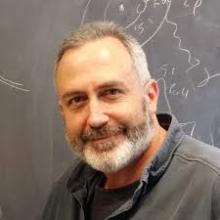
Seminar by Prof. Gerald Seidler (University of Washington) on "From the Early Days of Quantum Mechanics to Modern Analytical Practice: The History and Future of X-ray Absorption Spectroscopy."
18 Nov 2025
Seminar Room # 350, second floor annex
Speaker: Prof. Gerald Seidler
University of Washington, Seattle, United States
Title: "From the Early Days of Quantum Mechanics to Modern
Analytical Practice: The History and Future of X-ray
Absorption Spectroscopy."
Day and Date: Tuesday, November 18, 2025
Time: 14.00 Hrs.
Venue: Room no. 350, Chemistry Department
Second floor, Annex
------------------------------------------------------------------------
Hosted by Prof. Maheswaran Shanmugam
Talk Title : "From the Early Days of Quantum Mechanics to Modern Analytical Practice: The History and Future of X-ray Absorption Spectroscopy."
Abstract
Catalyst characterization follows well-defined analytical practices for each industrial
product line. For newly synthesized or newly manufactured supported heterogeneous catalysts,
one must establish that the desired surface areas, metal dispersions. and local atomic
environments have been achieved, so that the anticipated catalytic behavior is possible. On the
other hand, as the supported heterogeneous catalyst is used and gradually degrades, the testing
emphasis moves to the evaluation of a wide range of possible failure mechanisms.
In this seminar, I consider how the established, routine analysis of new and used catalysts
can be improved by laboratory-based X-ray Absorption Fine Structure (XAFS). XAFS has a long
history as a specialist synchrotron method giving uniquely direct information on the oxidation
state and local environment of metal species in supported heterogeneous catalysts. However,
easyXAFS launched a rebirth of laboratory XAFS in 2015 with to provide synchrotron-quality
spectra with immediate access. In our first ten years we have delivered more than 130
spectrometers to academic research groups around the world, and more than 60% of our
customers perform catalyst research.
As we begin to meet catalyst industry analytical needs with XAFS spectrometers and
with our new XAFS On Demand measurement services effort, we’ve learned a new reality:
XAFS applications for industrial materials testing often do not require new theoretical
calculations and advanced modeling. Instead, the needed product-specific figures of merit are
often qualitative or can be calibrated from samples at different chemical extremes. Even in cases
where expert care is needed to define a new XAFS-based test method, its subsequent execution
can be automated and does not require synchrotron expertise and high training in the theory and
analysis of XAFS. The situation is the same for optical spectroscopies, x-ray diffraction, and
NMR – neither those techniques nor XAFS are only for experts.
I will begin with a qualitative perspective on XAFS that equips non-experts with an
introductory interpretation of XAFS: bond length and coordination number evaluation, oxidation
state, and local coordination geometry. This will be followed with case studies on catalysts and,
finally, with discussion of possible use cases for laboratory XAFS in routine analysis of both
newly manufactured and deactivated industrial catalysts. This will include industrial
applications for both research and development of new materials and for improved quality
assurance of new and existing product lines.