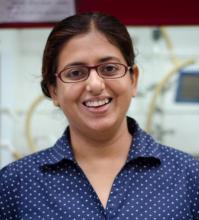
Departmental Seminar by Prof. Ankona Datta (TIFR Mumbai) on "Chemical Tools for Multiplexed Imaging in Living Systems".
06 Mar 2026
Seminar Room # 350, second floor annex
Speaker: Prof. Ankona Datta
Department of Chemical Sciences
Tata Institute of Fundamental Research
Homi Bhabha Road, Mumbai
Title: "Chemical Tools for Multiplexed Imaging in Living
Systems".
Day and Date: Friday, March 06, 2026
Time: 12.00 Noon.
Venue: Room no. 350, Chemistry Department
Second floor, Annex
-------------------------------------------------------------------------
Hosted by Prof. Debabrata Maiti
Talk Title : "Chemical Tools for Multiplexed Imaging in Living Systems".
Abstract
Correlated fluctuations in distributions of small molecules, ions, and macromolecules are central
to life processes, especially cell-regulation and signaling. Tracking these fluctuations can provide
unprecedented insights into how life works and what causes diseases. To track biomolecules,
live, we need molecular reporters or sensorsthat can non-invasively permeate living systems and
provide information on their spatiotemporal dynamics. The key is, simultaneous imaging of
multiple analytes1
in a particular biological location. Multiplexed spatiotemporal-imaging is,
however, challenging as: 1 Molecular reporters for individual analytes have to reach the same
biological destination, simultaneously; 2. Output signals of the sensors should be orthogonal or
non-overlapping. To address the first challenge, we have developed the concept of morphable
‘stitched’ sensors, where molecular reporters for different bio-analytes can be ‘stitched’ together
in a made-to-order, modular fashion to develop sensors for multiplexed imaging in a fluorescence
imaging platform.2 While fluorescence imaging affords the apt sensitivity for imaging bioanalytes,3-5
simultaneous imaging of more than two bio-analytes via fluorescence becomes
complicated due to broad emission features of fluorescence based molecular sensors. Hence, to
overcome the second challenge we have developed Activity-Based Alkyne-tag Raman sensors,
ABATaRs, for multi-analyte imaging, by leveraging sharp vibrational features of Raman spectra.1
In this talk, I will discuss these recent research directions in our group, through which we are
traversing from single-analyte sensing to multiplexed imaging.