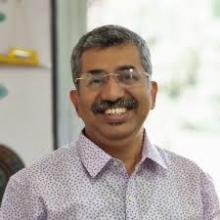
Seminar by Dr. Vaibhav A Mantri (Central Salt and Marine Chemicals Research Institute, Bhavnagar) on "Developments in Applied Phycology in India: With special reference to commercial cultivation of seaweed."
20 Apr 2026
Seminar Room # 350, second floor annex
------------------------------------------------------------------------
Speaker: Dr. Vaibhav A Mantri
CSIR- Central Salt and Marine Chemicals Research
Institute, Bhavnagar, India, 364002
Title: "Developments in Applied Phycology in India: With
special reference to commercial cultivation of
seaweed."
Day and Date: Monday, April 20, 2026
Time: 15.00 Hrs.
Venue: Room no. 350, Chemistry Department
Second floor, Annex
------------------------------------------------------------------------
Hosted by Prof. Arnab Dutta
Talk Title : "Developments in Applied Phycology in India: With special reference to commercial cultivation of seaweed."
Abstract
“Seaweed” is a colloquial term commonly applied to macroscopic,
multicellular, large marine algae that inhabit coastal as well as oceanic
waters. Prof. MOP Iyengar was the first Indian algologist who initiated
seaweed research in the country [Bull. Madras Govt. Mus. New Ser. Nat.
Hist., 1927, 185]. The century following this has witnessed a plethora of
research, development, demonstration and deployment in the domain of
conventional and more recently applied phycology in India. The efforts of
two visionary algologist Dr. Mrs. Francisca Thivy and Prof. V.
Krishnamurthy, who were instrumental in establishing India’s oldest
Phycological Society named ‘Seaweed Research and Utilization Association’
need to be sincerely acknowledged. These enduring efforts were responsible
for the establishment, advancement and progress of domestic seaweed-based
industries. At the cusp of its strategic expansion of the seaweed sector in
India, this talk is centred around enlisting and discussing key research
projects those were undertaken by CSIR-CSMCRI. This lecture provides a
broad-brush stroke picture of information in the areas of applied phycology
encompassing seaweed biodiversity, resource potential, IPR position,
industry processing and production. The landmark and innovative discoveries
those have translated in to business opportunities are discussed. The
commercial cultivation of Kappaphycus alvarezii in India has provided
diversification of livelihood to the fisherfolk those are involved in
seaweed gathering. The resilience of the commercial seaweed cultivation
section to the COVID-19 pandemic is briefly discussed. Further, the talk
delves into the regulatory, governance and policy support through various
Government agencies with special reference to the National Institution for
Transforming India (NITI Aayog), the apex public policy think tank of the
Government of India and the Ministry of Fisheries, Animal Husbandry and
Dairying of the Government of India. With the strategic perspective, the
Indian seaweed industry seems to be a successful example of achieving
“triple bottom line” objectives of balanced economic, social and
environmental outcome as proposed by the United Nations Department of
Economic and Social Affairs (UNDESA) and World Bank (WB).