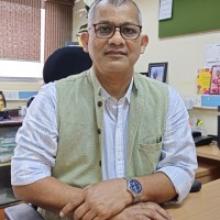
Seminar by Prof. Sundargopal Ghosh (IIT Madras) on "From Cyclopentadienyl to Boron Rings: An All-Boron Ferrocene Analog".
29 Apr 2026
Seminar Room # 350, second floor annex
Speaker: Prof. Sundargopal Ghosh
Department of Chemistry, Indian Institute of
Technology Madras, Chennai 600036
Title: "From Cyclopentadienyl to Boron Rings: An All-Boron
Ferrocene Analog".
Day and Date: Wednesday, April 29, 2026
Time: 15.00 Hrs.
Venue: Room no. 350, Chemistry Department
Second floor, Annex
-------------------------------------------------------------------------
Hosted by Prof. Arnab Dutta
Talk Title : "From Cyclopentadienyl to Boron Rings: An All-Boron Ferrocene Analog".
Abstract
The discovery of sandwich complexes with ferrocene (I) highlighted the fundamental
role of cyclopentadienyl (Cp) ligands in sandwich complexes. The tunability of Cp
ligands has inspired chemists to explore isoelectronic planar main-group rings (P5, As5,
Sb5, Bi5, Si5, B5) as alternative ligand frameworks aiming to achieve greater electronic
versatility. Notably, in 2002, the isolation of the fully inorganic metallocene, [Ti(P5)2]
2- (II),
marked the first 16e carbon-free sandwich complex. In contrast, boron rings remained
largely unexplored for decades due to the intrinsic electron deficiency of boron and its
preference for polyhedral cluster geometries. This perception was overturned by
transition-metal templation strategies. Grimes reported the first pentaborane ring
complex [(CpFe)B5H10], which was later extended to Ru and Ir analogues by Fehlner.
Recently, we have synthesized the Os analogue (III) using a Cp-based metal precursor.
Encouraged by these results, we attempted to synthesize carbon-free sandwich
complexes using various metal precursors, for example, [M2(μ-Cl)2(COD)2] (M = Ir, Rh),
[M(PPh3)3Cl2] (M = Ru, Os), [Cp*Fe(dppe)Cl] and [Fe(dppe)Cl2]n; however, these efforts
were unsuccessful. Interestingly, using [Os(PPh3)3Cl2] and [Cp*OsBr2]2 as precursors, we
have isolated a tetraborane [B4H8] 2- (IV) and a hexaborane [B6H11] - (V) rings, stabilized by the monometallic Os-templates. These results will be discussed in detail.