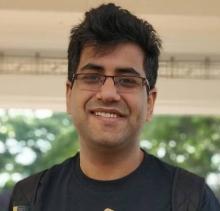
Seminar by Prof. Mohit K. Jolly(IISc. Bengaluru) on "Design principles of complex cell-state transition regulatory networks in cancer."
03 Jul 2026
Seminar Room # 350, second floor annex
Speaker: Prof. Mohit K. Jolly
Associate Professor, Centre for BioSystems Science
and Engineering (BSSE),Indian Institute of Science,
Bengaluru, India 560012
Title: "Design principles of complex cell-state transition
regulatory networks in cancer."
Day and Date: Friday, July 03, 2026
Time: 16.00 Hrs.
Venue: Room no. 350, Chemistry Department
Second floor, Annex
------------------------------------------------------------------------
Hosted by Prof. Sandip Kar
Talk Title : "Design principles of complex cell-state transition regulatory networks in cancer."
Abstract
Elucidating the design principles of regulatory networks driving cellular
decision-making is of fundamental importance in mapping and controlling
cellular behaviour. Despite their size and complexity, large biological
regulatory networks often lead to a limited number of
cell-states/phenotypes. How this canalization is achieved remains largely
elusive. Here, we investigated multiple different networks governing
reversible cell-state transitions during cancer metastasis, and
identified a latent design principle in their topology that constrains
their phenotypic repertoire – the presence of two "teams" of nodes
engaging in a mutually inhibitory feedback loop. These "teams" are
specific to these networks and directly shape the phenotypic landscape and
consequently the cell-fate trajectories. We also
present the experimental evidence of such "teams" in bulk, single-cell and
spatial transcriptomic datasets across many contexts (cancer cell
plasticity in breast cancer, melanoma, lung cancer etc.), including those
in perturbation studies. Overall, we propose these "teams" as a network
design principle that drive cell-fate canalization in diverse
decision-making processes, and drastically reduce the dimensionality of
the phenotypic space, with implications in cancer cell fitness and patient
survival.