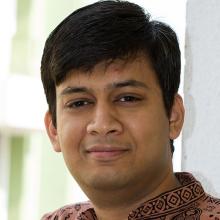
Departmental Seminar by Prof. Suman Chakrabarty (S. N. Bose National Centre for Basic Sciences, Kolkata)
04 Nov 2026
Seminar Room # 350, second floor annex
------------------------------------------------------------------------
Speaker: Prof. Suman Chakrabarty
Department of Chemical and Biological Sciences
S. N. Bose National Centre for Basic Sciences,
Kolkata, India
Topic: "Protein Conformational Landscapes in Allostery and Drug
Discovery"
Day and Date: Wednesday, November 04, 2026
Time: 12.00 noon
Venue: Room no. 350, Chemistry Department
Second floor, Annex
------------------------------------------------------------------------
Hosted by Prof. Ruchi Anand & Prof. Chidambar Kulkarni
Talk Title : "Protein Conformational Landscapes in Allostery and Drug Discovery"
Abstract
Protein function is intimately connected to the populations of accessible conformational states and the
transitions between them. Low-population metastable states can influence molecular recognition and allosteric
regulation, while exposing transient binding pockets that offer opportunities for drug discovery. Understanding
these processes requires us to examine both the underlying free-energy landscape and the kinetics of
interconversion between states.
In this talk, we shall discuss our recent efforts to understand and exploit this conformational heterogeneity using
molecular simulations.[1–3] We shall examine how ligand binding and local perturbations redistribute
conformational populations and reorganise inter-residue interaction networks, providing a molecular basis for
allosteric communication. With examples from therapeutically important protein–protein interactions, we shall
illustrate how mixed-solvent simulations can identify binding hotspots and reveal cryptic pockets. Our studies of
PCSK9 and the polo-box domain of PLK1 suggest potential sites for allosteric modulation and highlight the
importance of establishing their coupling to functional interfaces.[2,3]
Accessing the relevant states and transitions remains a major sampling challenge. We shall therefore present our
recent methodological developments: PathGennie for rapid generation of candidate rare-event pathways,
TRAILS-MD for adaptive exploration of conformational landscapes with explicit tracking of trajectory ancestry,
and WePath for investigating pathway-dependent kinetics using neural-network-guided weighted ensemble
simulations.[4–6] Examples involving conformational transitions and ligand dissociation will illustrate how
these complementary approaches connect the discovery of metastable states to mechanistic pathways and kinetic
characterisation. Particular emphasis will be placed on drug dissociation pathways and residence times, which
provide information complementary to binding affinity. Together, these studies link the physical basis of
allostery to computational strategies for discovering and characterising potential therapeutic targets.